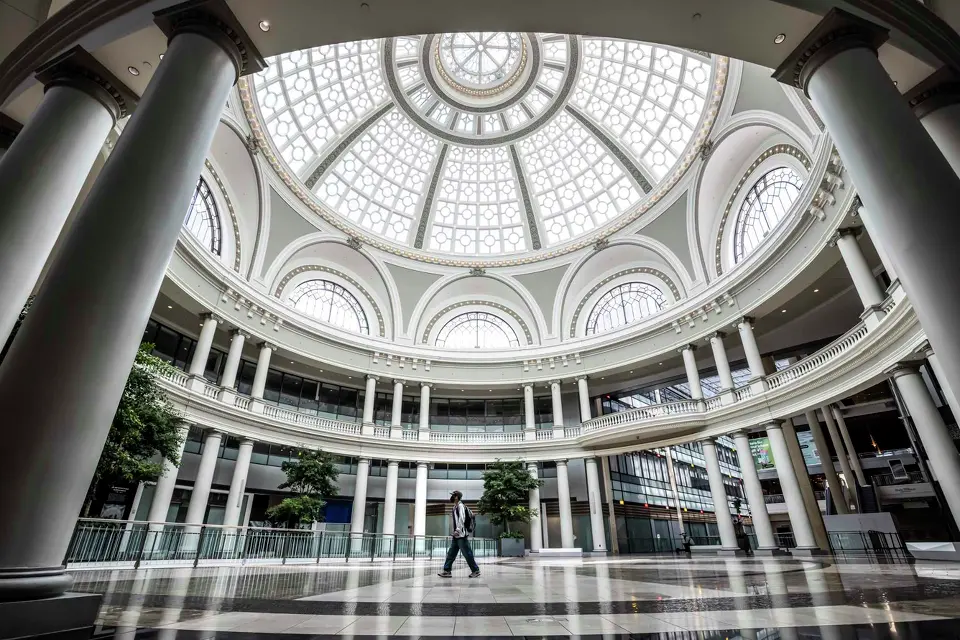
A lone visitor walks under the dome at the San Francisco Centre mall in San Francisco last year. A development firm has asked the city if the mall, which has been shuttered for months, could become a data center.
It was, perhaps, only a matter of time before the controversial industry seeking large swaths of available land looked longingly at San Francisco’s shuttered downtown mall, one of the city’s most troubled pieces of procurable real estate.
According to records obtained by the Chronicle, Maryland-based KG Growth Partners asked the city in June about data center permitting, saying the firm is working with an unidentified potential buyer for 845 Market St., the address of the 350,000-square-foot portion of the mall formerly occupied by Bloomingdale’s.
“I just wanted to see what permits we would need for an AI Data Center,” KG’s construction consultant, Trenton Hartlaub, said in an email to the San Francisco Department of Building Inspection. As of Friday, no application had been filed with the city to build a data center.
Article continues below this ad
Opposition to data center construction has become a national phenomenon and an issue in next month’s midterm elections. Despite San Francisco emerging as the world’s focal point for AI development, concerns about data centers locally led Mayor Daniel Lurie last week to sign a moratorium barring the city from approving new facilities for 45 days as officials study their impacts and consider how to regulate them.

A mural wrap is applied to the facade of the former Bloomingdale’s store on the Mission Street side in San Francisco in January.
Concerns have focused on sprawling energy farms that have been criticized for the amount of power and water they consume, while disrupting adjacent communities. Jared Krieger, CEO of the development, funding and strategy firm, said KG does not comment on “live transactions” but stressed that the firm’s projects do not involve building “a conventional suburban server farm.”
“The model is a conversion that keeps the ground floor and the public-facing levels of the building active and open, with the technical use in the upper floors and back-of-house space,” he said in an email Sunday morning. “Downtown San Francisco has a vacancy problem in exactly this building type, and the premise is that reuse with a mixed public and technical program does more for the block than a dark box does.”
In response to additional questions from the Chronicle, Krieger elaborated.
Article continues below this ad
“Our client is interested, in partnership with a known AI Lab, in developing the mall property, including Bloomingdale’s, into an AI-controlled living space,” Krieger said, adding that the planned facility’s “proprietary AI design can utilize resources, such as dedicating water to a rooftop garden. This would then be donated to a nonprofit focusing on food insecurity for use in transient shelters.”
Besides potential public opposition that could lead to opposition from City Hall, the project faces numerous hurdles, including whether the company working with KG can successfully complete the purchase of the property and whether the site can draw the amount of electrical power and other resources needed by a data center.
Lurie has said he envisions a downtown district where people can work, live, play and learn. A data center between Market and Mission, two of the city’s most storied streets, would strike many to be the antithesis of that vision, even if it were part of a mixed-use facility.
But the mall has become an embarrassing eyesore for the city and a symbol of its struggles to recover from the pandemic. A sale of the property failed earlier this year. Potential alternate uses for the site, like a soccer stadium or a basketball facility, have been floated.
What do you think about a data center going into SF’s shuttered mall?
Jaine G
Berkeley, CA
10/19/26
If the project can include renewable energy generation and water conservation/recycling to cover the excess water and power required for the data center, I would not object
Madeline P
Novato, CA
10/19/26
The available space is a wonderful opportunity for the City to develop an Indoor Park, Art/Event Space as the hub of Lurie’s vision for the downtown district
Nick C
San Francisco, CA
10/19/26
Over my dead body.
Josh K
San Francisco, CA
10/19/26
I don’t think that should be a data center. Do different things in each mall section: educational resources, sports space, art studios, Chelsea market style hall, offices.
The city needs to consider how people get there too. Commuting patterns have changed and BART isn’t going to drive foot traffic the same way it did in the 2010s. That influences what’s viable there.
Constance N
Danville, CA
10/19/26
I’m a native of SF, but live in east bay. I think that if the use that is described can benefit the city, then it would be OK. As long as lower and street levels have retail & food, then there would be good foot traffic. I take BART to city and Giants games. I feel sad that the mall collapsed as I used to shop there before the pandemic.
The complex, whose historic beaux arts facade dates back to the 1890s, sits between Union Square and Yerba Buena Gardens, next to a major transit hub and ringed by hotels, restaurants and other businesses. Its enclosed, cavernous design with few windows makes the dead mall difficult to adapt: deep interior spaces receive little natural light, a major obstacle to converting the property to housing. The property’s split ownership and a long-term ground lease add a layer of complexity to its future in the surrounding ecosystem.
Article continues below this ad
Two local real estate and City Hall sources granted anonymity under Chronicle guidelines suggested that City Hall might not immediately rule out a data center at the mothballed mall. Officials could be receptive to a plan that keeps the ground floor active and public-facing, with workspaces on the upper levels, these people said.
“There is an interest in just making something work,” a source with insight into the city’s downtown recovery efforts said.
Krieger declined to name KG’s client in the proposed project, saying only that it’s a technology company. KG’s website says it is seeking hundreds of millions of dollars for unnamed sponsors’ “AI-aligned, net positive” infrastructure projects in San Francisco, Los Angeles, Houston and Detroit.
Last month, the Chronicle reported that B3 Investors, an arm of a Texas-based commercial real estate firm, was said to be nearing a deal for the Bloomingdale’s parcel, which is owned by parent company Macy’s separately from the rest of the 1.5 million-square-foot mall, and spans about one-third of it. B3 has also bid on the rest of San Francisco Centre, which was foreclosed on by its lenders last November, according to sources with insight into the sales process.

The San Francisco Centre mall has been closed since January, after a wave of store closures rendered it virtually empty.
B3 has been converting the former Bayfair mall in San Leandro into Speedway at Bayfair, a research, development and innovation campus with flexible floor plates and “robust power and infrastructure,” according to its website.
Article continues below this ad
B3 did not respond to questions sent by the Chronicle about the pending acquisition, its plans for the property, and whether it is working with KG.
Representatives for Macy’s and Bloomingdale’s have declined to confirm the identity of the buyer for their portion of the mall, or confirm whether the deal has closed. Real estate sources familiar with the negotiations, who were granted anonymity by the Chronicle, said it has not. They value the potential transaction at about $40 million.
Krieger said his firm works with “public-access ventures, public enterprises and mission-driven developers.” The firm advises project sponsors on strategy and financing and helps secure grants and other non-dilutive funding. Krieger, described on KG’s website as having degrees in homeland security and disaster management, said the firm does not buy properties or operate data centers, but helps projects secure public grants, corporate sponsorships, and institutional or philanthropic partnerships. It does not raise private capital, place equity or debt, or solicit investors.
“I’m not in a position to describe the capital structure of a transaction that isn’t ours and is still live,” he said of 845 Market.
Veteran developers Presidio Bay Ventures and Prado Group agreed to buy the mall complex earlier this year, reportedly planning to convert part of it into new offices while retaining some retail space. They walked away in July after months of due diligence, citing failed talks to renegotiate a ground lease for a portion of the property with the San Francisco Unified School District, which has owned the underlying land for decades.
Article continues below this ad
The lease was later extended through 2082 with lower payments in an effort to help facilitate the property’s sale, but the mall still returned to the market.
Some real estate insiders have spoken of the challenges in raising capital for a high-risk acquisition such as a shuttered, nearly block-long retail center whose scale and configuration make it difficult to repurpose.
“Apartments still don’t pencil due to costs, and office vacancy is still very high,” one real estate source focused on revitalizing vacant properties in the neighborhood surrounding the mall told the Chronicle. “So tough to make anything work.”
The city’s AI boom, meanwhile, is pushing demand past conventional offices. Companies developing “physical AI” — robots and other machines that operate in the real world — need space to build and test hardware, with enough electrical capacity to run it.
“Without question, an R&D lab is on the table,” a real estate source told the Chronicle, referring to the vacant former Bloomingdale’s space. The source said the distressed property’s basis — the buyer’s cost to acquire it — is “low,” potentially leaving room to invest in converting the mall to a use that is more in demand.
The mall already had an office component on its western side near the Bloomingdale’s space, which housed San Francisco State University’s downtown campus and other office tenants long before it closed last year. Separately, the city approved converting nearly 50,000 square feet on the upper floor of the mall’s Nordstrom wing, on the east side near Fifth Street, to offices prior to the pandemic.
A separate data center concept by developer Nestory Park Capital has been floated for the city’s Central Waterfront. That would pair a data center with office space for a technology tenant — a more integrated use than the stand-alone server campuses driving data-center proposals elsewhere. No formal plans for the project have been filed with the city.
Amid all of this, City Hall is racing to study and potentially write new rules for data centers, a use it has broadly defined and loosely tracked. The 45-day moratorium gives planning department staff time to assess existing facilities and consider new standards.
The department said, in records obtained by the Chronicle, that it has only approved two new data centers since the city added a zoning category for the use in 2001, classifying them as “internet service exchanges.” But that definition includes telecom, fiber and cable exchanges, including smaller network facilities downtown — not just high-energy AI data centers.
Planning Director Sarah Dennis Phillips told Supervisor Shamann Walton, in an email last month that was obtained by the Chronicle, that the city’s broad definition paired with a required conditional use permit, has allowed officials to scrutinize related facilities — including new configurations that combine data center functions with other uses. A narrow definition, she wrote, could miss projects as the technology evolves, though she said the department was “happy to explore” changes.